
Multi-Race Exotics: Pick 3 and Pick 4 Strategy
 Available in US
Multi-race exotic wagers extend the challenge and potential reward of exotic betting across consecutive races. Instead of predicting which horses will fill specific positions in a single race, you must identify winners across three, four, or more races on a single ticket. The Pick 3 requires selecting winners in three consecutive races; the Pick 4 extends the challenge to four races. These horizontal wagers offer substantial payouts when correctly handicapped because the difficulty of hitting multiple winners in sequence generates pools that reward successful bettors generously.
Make really smart choices with bookmakers-bet.
The structural advantage of multi-race exotics lies in their separate betting pools. When you bet a Pick 3, your wager enters a dedicated pool where takeout applies only once to your investment. Compare this to betting three separate win wagers, each subject to individual takeout of 15-17%. The consolidated pool structure means more of your money goes toward potential winnings rather than track extraction, making multi-race exotics mathematically more efficient than equivalent straight betting strategies.
Multi-race exotics also test a broader range of handicapping skills than single-race boxes. You must evaluate pace scenarios, class levels, trainer patterns, and all other factors across multiple races, then synthesize these assessments into ticket constructions that balance coverage with cost. The complexity creates opportunity because most bettors fail to think systematically about multi-race sequences, leaving value for those who approach the challenge methodically.
Table of Contents
Singles and Spreads
The fundamental strategic decision in multi-race betting involves when to single and when to spread. Singling means selecting only one horse in a leg, betting your conviction that this horse will win. Spreading means including multiple horses in a leg, acknowledging uncertainty about which contender will prevail. Every multi-race ticket combines singles and spreads according to the bettor’s confidence across the sequence.
Singles reduce ticket cost dramatically. A Pick 4 with one horse in each leg costs only the base wager amount. A Pick 4 with three horses in each leg costs 81 times the base amount. The difference between a $1 ticket and an $81 ticket determines how many combinations you can afford and what return you need to profit. Strategic singling in legs where you have high confidence frees resources to spread in legs where uncertainty demands coverage.
The conventional approach singles heavy favorites and spreads in competitive races. This strategy has logical appeal but suffers a critical flaw: everyone else plays the same way. When a heavy favorite wins, nearly all tickets survive that leg, meaning no separation occurs among bettors and payoffs remain modest. The favorite’s victory helps you stay alive but does not generate value because you have the same horses as everyone else.
Contrarian strategy flips the conventional approach. Single in competitive races where you have strong opinions that differ from public consensus. Spread in races featuring vulnerable favorites where upset potential creates separation opportunity. When the public’s favored horse loses, tickets containing only that horse become losers, dramatically reducing competition for the pool and increasing payoffs for surviving tickets even if the remaining legs produce expected results.
Pick 3 Construction
The Pick 3 offers an accessible entry point to multi-race wagering. Three consecutive races provide enough complexity to generate attractive payoffs while remaining manageable for developing handicappers. Most tracks offer rolling Pick 3s throughout the card, allowing you to select sequences that match your strongest opinions rather than being limited to designated races.
Look for Pick 3 sequences containing one or two races where you have clear opinions and one competitive race where spreading makes sense. A typical structure might single your top selection in the first leg, spread three horses in the second leg where the race appears more open, and single again in the third leg where you have conviction. This 1 x 3 x 1 structure costs three times the base bet and concentrates your investment on your strongest opinions.
Multiple tickets at different bet amounts can optimize payouts. Your main ticket might use your top selection plus a secondary contender in each leg, ensuring survival if your first choice fails. A separate key ticket singles your top choice in all three legs at a higher denomination, maximizing payoff if your prime selections sweep. A backup ticket includes longshots you respect but do not expect to win. This tiered approach balances coverage with cost efficiency.
Pick 3 median payoffs typically range from $25 to $50, making them attractive for concentrated plays. If you can identify a live longshot in one leg, the Pick 3 becomes an efficient vehicle to leverage that opinion across two other races. The longshot’s victory eliminates most competing tickets, generating enhanced payoffs even if favorites win the other legs.
Pick 4 Construction
The Pick 4 adds a fourth leg, dramatically increasing both difficulty and potential reward. With four races to navigate, the probability of hitting all winners drops while payoffs rise correspondingly. Pool sizes often exceed those of Pick 3s because the glamour of potential four-figure scores attracts substantial betting interest.
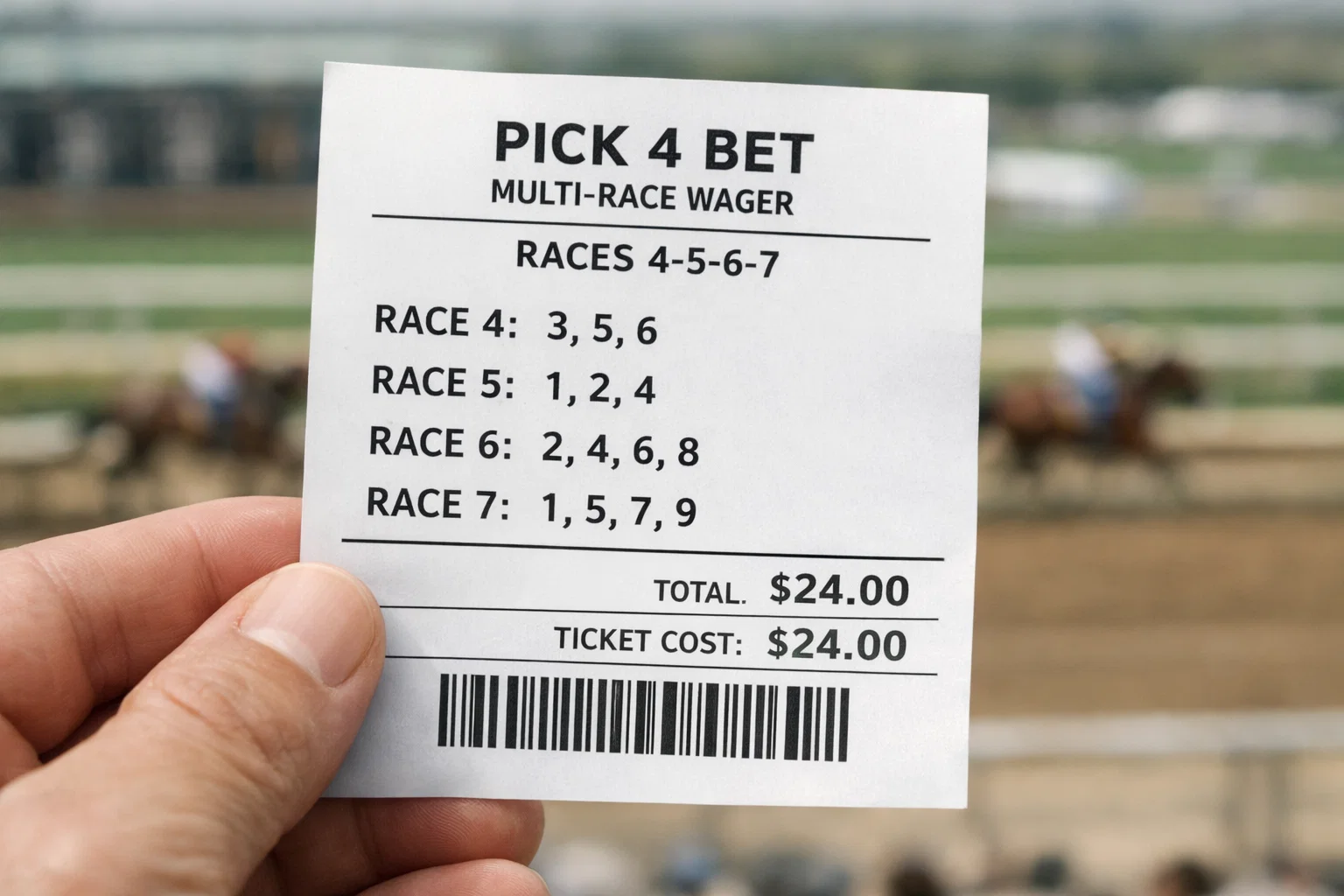
The four-leg structure requires more sophisticated ticket architecture. Most successful Pick 4 players build around one or two key horses they expect to win at prices exceeding public expectation. These value plays anchor the ticket while other legs receive spreading treatment based on the bettor’s confidence and budget. A ticket built around two key horses might structure as 2 x 1 x 3 x 2, producing 12 combinations at reasonable cost while maintaining focus on the bettor’s strongest opinions.
Singling in the middle of a Pick 4 sequence, rather than at the beginning or end, can prove strategically valuable. If your single wins, you have already navigated the critical separation point while tickets still have multiple chances to lose on either side. Middle singles also provide psychological benefits by revealing early whether your ticket remains alive without requiring survival of all preceding legs.
Carryover pools occur when no ticket correctly selects all winners and the pool carries forward to the next racing day. These jackpot situations attract increased betting interest and can generate six-figure payoffs. When carryover pools grow substantial, consider allocating additional resources to Pick 4 play because the expected value per dollar wagered increases with pool size.
Read our detailed pool size guide.
Ticket Mathematics
Understanding the cost mathematics of multi-race tickets enables efficient construction within any budget. The formula is straightforward: multiply the number of horses in each leg together, then multiply by the base wager. A 3 x 2 x 4 Pick 3 at $1 costs 3 x 2 x 4 = 24 combinations x $1 = $24. A 2 x 3 x 2 x 4 Pick 4 at fifty cents costs 2 x 3 x 2 x 4 = 48 combinations x $0.50 = $24.
Budget constraints force trade-offs between coverage and bet size. A $50 budget could fund a 5 x 2 x 5 Pick 3 at $1 per combination or a 5 x 2 x 5 Pick 3 at $2 per combination with half the coverage. The decision depends on your confidence in the selections. If you are highly confident in your contenders, higher denomination tickets on fewer combinations maximize payoff when you hit. If uncertainty dominates, lower denominations on more combinations maximize survival probability.
Always calculate ticket cost before finalizing selections. It is easy to add horses to legs without realizing how quickly costs multiply. Adding one horse to a leg doubles the ticket cost if the leg previously contained one horse. Adding one horse to a leg containing three horses increases cost by one-third. Understand these relationships to avoid budget surprises and make intentional decisions about coverage versus cost.
Sequence Selection

Not all Pick 3 and Pick 4 sequences offer equal value. Look for sequences containing races where you have genuine insight and races where longshots can realistically compete. A sequence filled with short-priced favorites produces modest payoffs regardless of outcome. A sequence containing competitive races with live longshots offers explosive payout potential.
Evaluate the races in each sequence before committing to play. If every race features a dominant, deserving favorite, the Pick 3 or Pick 4 may not offer sufficient value to justify the investment. If one or more races feature vulnerable favorites or competitive fields without clear separation, the sequence becomes more attractive.
Consider the relationship between races in the sequence. Some tracks construct sequences strategically, placing maiden races alongside allowance events alongside stakes races. This variety creates natural separation points because different types of races attract different betting patterns. Maiden races with first-time starters offer uncertainty that can eliminate many tickets when favorites fail.
Rolling Pick 3s allow sequence selection throughout the card. Rather than playing designated Pick 4s that might contain races you have not studied, focus on three-race sequences where your handicapping has generated strong opinions. This selective approach concentrates your investment on opportunities where your analysis provides edge rather than forcing plays on races you have not thoroughly evaluated.
Multi-race exotics reward systematic handicapping and strategic ticket construction. The horizontal nature of these wagers tests your ability to sustain accurate predictions across multiple races while managing costs through intelligent use of singles and spreads. Developing competence in Pick 3 and Pick 4 wagering adds a powerful tool to your exotic betting arsenal.
