
Superfecta Box Strategy: When the Payouts Justify the Cost
 Available in US
The superfecta represents the Mount Everest of single-race exotic wagering, demanding that bettors correctly identify the first four finishers in exact order. This level of precision would be nearly impossible without boxing, which covers every permutation of your selected horses across the top four positions. The superfecta box transforms an impossible prediction into a manageable probability game, though the costs can escalate rapidly enough to swallow potential profits if you are not careful.
Double your betting income with bookmakers-bet.
What makes the superfecta compelling is the sheer magnitude of potential payouts. The 2022 Kentucky Derby superfecta paid $321,500.10 on a $1 wager when 80-1 longshot Rich Strike shocked the racing world. Even in smaller races at regional tracks, superfecta payouts routinely reach four and five figures because so few bettors successfully identify four horses in correct sequence. The challenge is structuring your superfecta plays so that the cost of coverage does not exceed the likely return.
The dime superfecta, offered at many tracks with a $0.10 minimum, has democratized access to this exotic wager. Where a four-horse superfecta box once cost $24 at the $1 minimum, it now costs just $2.40 at the ten-cent base. This reduction allows recreational bettors to participate in the superfecta lottery without significant financial risk while maintaining meaningful upside if they hit.
Table of Contents
Understanding the Cost Structure
The superfecta box formula follows the same permutation logic as other exotic boxes but adds a fourth position: n x (n-1) x (n-2) x (n-3) x base wager. With four horses in a box, the calculation runs 4 x 3 x 2 x 1 = 24 combinations. At the $0.10 minimum, this costs $2.40. At $1, it costs $24. These numbers sound reasonable until you start adding horses.
A five-horse superfecta box jumps to 5 x 4 x 3 x 2 = 120 combinations. At the dime minimum, that is $12; at $1, it is $120. Six horses produces 360 combinations at $36 or $360. Seven horses reaches 840 combinations at $84 or $840. Eight horses generates 1,680 combinations at $168 or $1,680. The progression accelerates so dramatically that boxing more than five or six horses becomes financially impractical for most bettors.
The relationship between box size and expected payout determines whether a superfecta box offers positive expected value. If a five-horse box costs $120 and the likely superfecta payout is $800, you are getting roughly 6.5:1 on your investment. If the same box costs $120 but the likely payout is only $200 because favorites dominated, you are looking at a break-even proposition at best. Evaluating probable payouts before committing to a box separates strategic players from those simply hoping for luck.
| Horses | Combinations | $0.10 Cost | $0.50 Cost | $1.00 Cost |
|---|---|---|---|---|
| 4 | 24 | $2.40 | $12.00 | $24.00 |
| 5 | 120 | $12.00 | $60.00 | $120.00 |
| 6 | 360 | $36.00 | $180.00 | $360.00 |
| 7 | 840 | $84.00 | $420.00 | $840.00 |
| 8 | 1,680 | $168.00 | $840.00 | $1,680.00 |
Identifying Value Opportunities
Not every race justifies superfecta play. The best superfecta opportunities share specific characteristics: competitive fields without overwhelming favorites, sufficient pool size to generate meaningful payouts, and handicappable races where form analysis can identify legitimate contenders.
Large-field stakes races represent the sweet spot for superfecta value. The Kentucky Derby with its twenty-horse field generates superfecta pools often exceeding $5 million, ensuring that any combination involving even one longshot pays handsomely. The Preakness and Belmont Stakes offer similar opportunities, as do major Grade 1 events at tracks like Santa Anita, Belmont Park, and Keeneland. These races attract enough betting volume that superfecta payouts can reach life-changing levels while the large fields make predicting exact order genuinely difficult.
Competitive allowance and stakes races at major tracks also provide superfecta value, particularly when the morning line shows three or four horses at similar odds. A race where horses 2, 5, 8, and 11 all show 4-1 or 5-1 morning lines suggests genuine uncertainty about finishing order, which translates to larger superfecta payouts when the race unfolds. Compare this to a race with a 3-5 favorite and a 2-1 second choice; the compressed odds virtually guarantee a modest superfecta payout regardless of who fills out the third and fourth spots.
Avoid superfecta boxes in short fields. A six-horse field might seem like an opportunity because fewer horses means easier prediction, but the math works against you. A four-horse box in a six-horse field covers 24 of 360 possible superfecta combinations, or about 6.7%. The same box in a twelve-horse field covers 24 of 11,880 possible combinations, about 0.2%. The larger field creates more difficulty but also generates proportionally larger payouts, making the risk-reward equation more favorable.
Strategic Box Construction
The most common mistake in superfecta boxing is treating all horses in the box as equally likely to occupy each position. In reality, your handicapping has probably identified stronger candidates for the win position and progressively weaker candidates for fourth. Acknowledging this hierarchy leads to more efficient betting structures.
The key superfecta approach offers one alternative to full boxing. You select one horse as your anchor in the win position and box three or more additional horses across second, third, and fourth. If your top selection wins and your other horses sweep the remaining positions, you cash. This structure dramatically reduces costs while maintaining exposure to quality payouts. A key superfecta with one horse on top and three others boxed underneath costs just $6 at the $1 level, compared to $24 for a full four-horse box.
Part-wheel constructions provide even more flexibility. You might place two horses in the win position, three horses in the place position, four horses in the show position, and five horses in the fourth position. The combinations multiply according to your position selections, allowing you to emphasize horses where they are most likely to finish while providing coverage where uncertainty exists. Part-wheels require more thought than full boxes but offer superior cost efficiency for handicappers with genuine opinions about race outcomes.
The dime superfecta enables creative coverage that would be impossibly expensive at higher minimums. At $0.10 per combination, a six-horse box costs $36, allowing you to spread across multiple contenders without catastrophic risk. Some bettors use the dime superfecta to construct multiple tickets with different structures: a main ticket keying their top selection with their secondary contenders, and a backup ticket reversing the order in case the second choice upsets. Total investment might reach $20-30 while covering numerous scenarios.
Check the exact wheel bets cost.
Major Race Applications
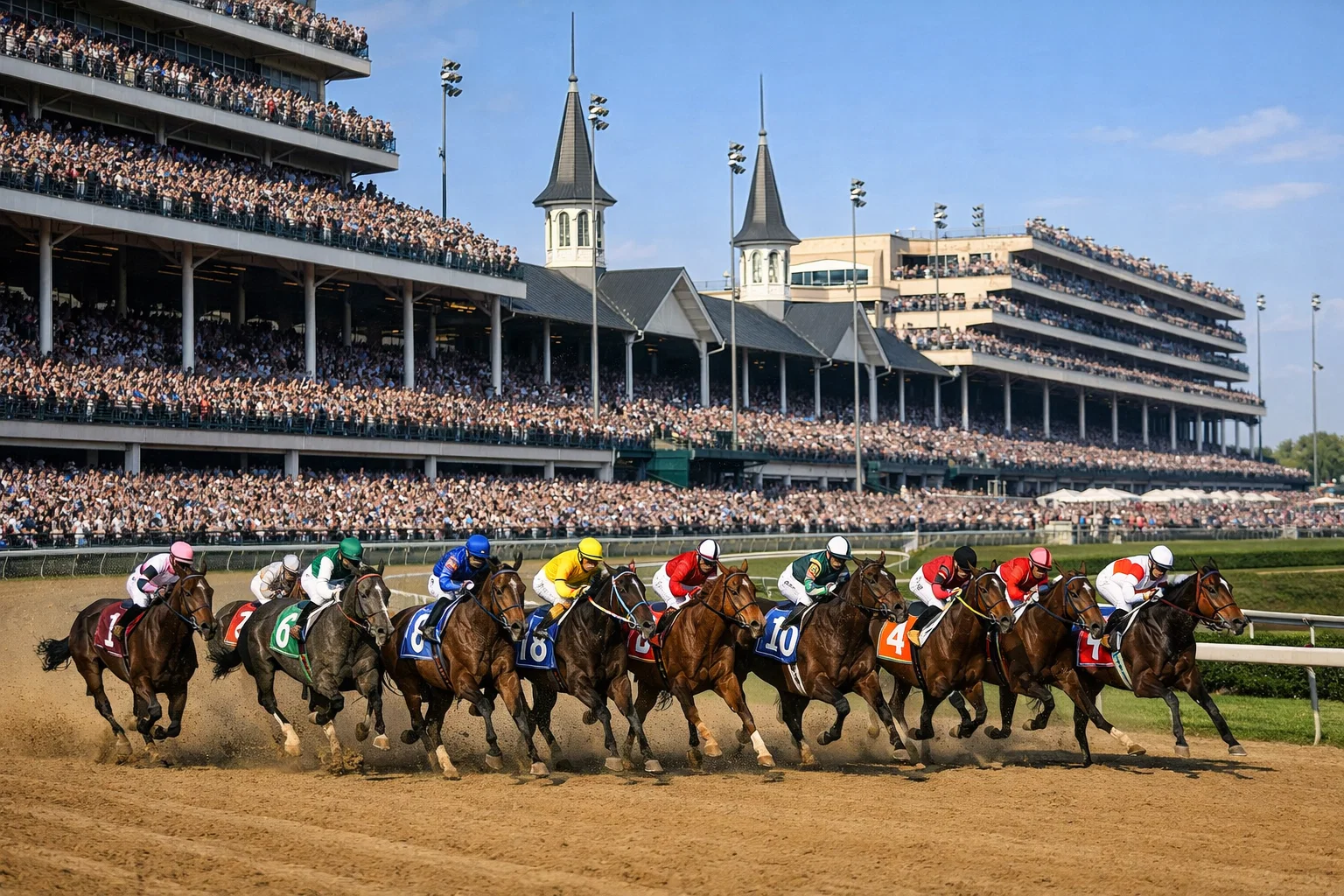
The Kentucky Derby provides the ultimate superfecta testing ground. With twenty horses, massive betting pools, and frequent longshot intrusions into the top four, Derby superfecta payouts have averaged over $50,000 for $1 wagers over the past decade. The 2022 Rich Strike superfecta at $321,500 represents an extreme example, but four-figure payouts are common even when favorites finish in the money.
Derby superfecta strategy typically involves identifying horses by tier. The top tier includes two or three legitimate win contenders based on class, form, and pedigree. The second tier includes four or five horses capable of placing but unlikely to win. The third tier identifies longshots with enough ability to sneak into third or fourth but minimal winning chances. A well-constructed part-wheel uses horses from each tier in their appropriate positions.
A sample Derby superfecta structure might key two win contenders over four place contenders over six show contenders over eight fourth-place contenders. At the dime minimum, this creates hundreds of combinations but costs less than $100 while providing coverage for multiple scenarios. If one of your top contenders wins and you have correctly identified horses for the remaining spots, you cash a ticket that could pay anywhere from a few hundred dollars to tens of thousands depending on which specific horses fill the positions.
The Breeders’ Cup Classic and other championship events offer similar opportunities with smaller fields but equally competitive dynamics. Eight to twelve horse fields with legitimate chances spread across multiple contenders create superfecta pools that regularly pay four figures. These races attract sophisticated betting pools where value exists for those willing to dig into the handicapping.
Risk Management
Superfecta betting requires disciplined bankroll management because the hit rate is inherently low. Even well-constructed boxes might cash only once in ten or twenty attempts, meaning you must size your bets to withstand extended losing runs while maintaining exposure to the big payouts that justify the strategy.
A reasonable approach allocates 2-3% of your racing bankroll to superfecta play on any single race. If your bankroll is $1,000, that translates to $20-30 per superfecta opportunity. At the dime minimum, this budget allows for meaningful coverage in competitive races without risking financial stress during inevitable cold streaks.
Tracking results becomes essential for superfecta players. Record every superfecta bet including cost, structure, and outcome. After fifty or a hundred plays, patterns emerge. Perhaps your keyed superfectas show positive ROI while your full boxes lose money. Maybe your part-wheels with longshots in fourth outperform your conservative structures. Data-driven adjustments improve long-term results far more than intuition or gut feeling.
Resist the temptation to increase superfecta spending after near-misses. Hitting three of four horses in a superfecta feels agonizing, but it provides no information about whether your fourth selection was reasonable. The near-miss might represent bad luck or might signal a flaw in your handicapping. Either way, chasing with larger bets rarely ends well.
The superfecta box remains one of racing’s most exciting wagers precisely because it offers the possibility of life-changing payouts from modest investments. But possibility is not probability, and the smart superfecta player understands that cost control, strategic construction, and disciplined bankroll management separate long-term profitability from expensive entertainment. When the race conditions align, the pool size supports meaningful payouts, and your handicapping identifies genuine contenders, the superfecta box becomes a powerful weapon in your exotic wagering arsenal.
